AI vs Manual HR Policy Writing — Which Is Better
Introduction
Writing HR policies has always been a balancing act between accuracy, compliance, and practicality. Traditionally, HR managers or consultants spent weeks crafting policies that reflect company culture, adhere to laws, and protect both employers and employees. But in today’s fast-paced, tech-driven world, a new contender has entered the scene — AI HR policy writing.
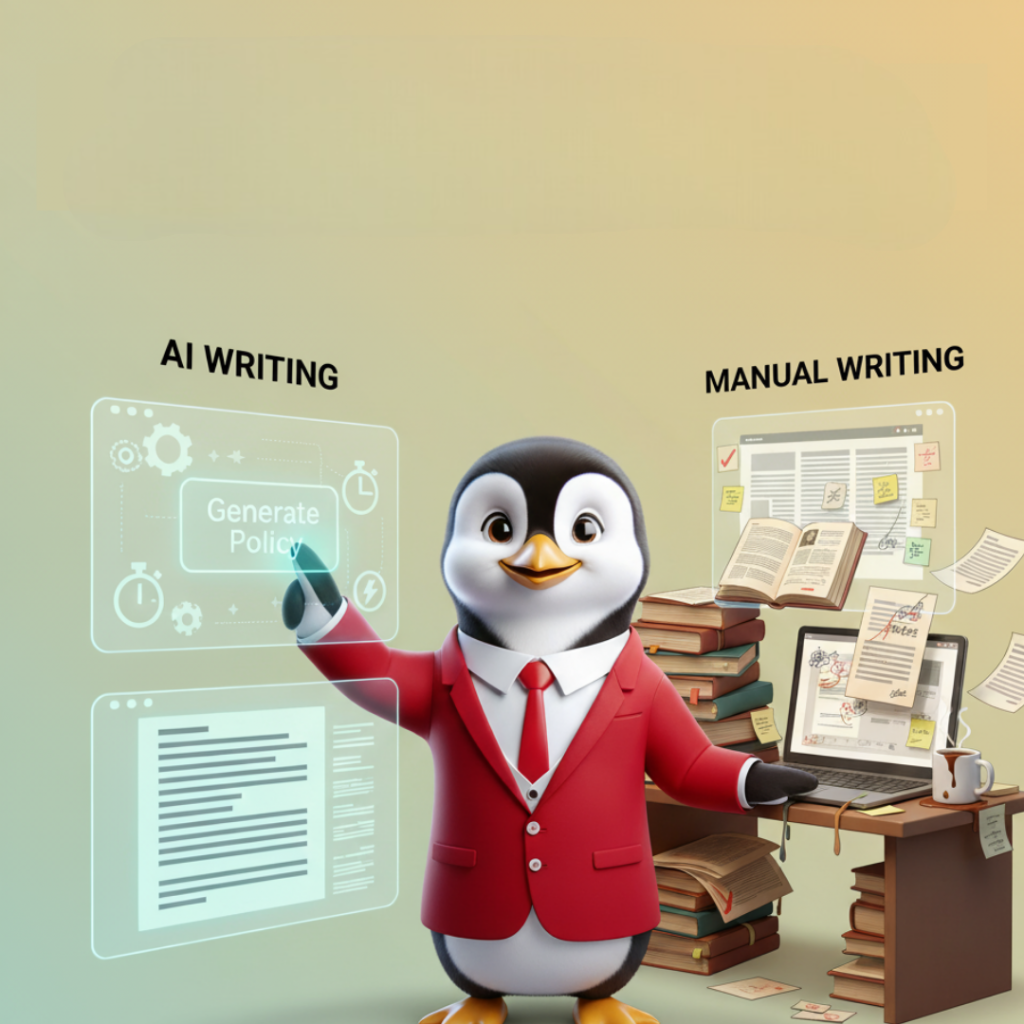
The question now isn’t whether AI can write HR policies, but how well it does compared to manual writing. Let’s dive deep into both methods and see which one truly delivers the best results for modern organizations.
The Traditional Way: Manual HR Policy Writing
Before artificial intelligence changed the landscape, HR policy creation was an entirely manual process. Companies often relied on HR experts, consultants, or legal teams to draft policies from scratch. Every clause, paragraph, and section required deliberate thought and cross-checking against labor laws.
Advantages of Manual HR Policy Writing
- Human Experience and Judgment:
HR consultants bring deep contextual understanding. They can interpret the unique nuances of your company culture and industry.
- Customization:
A human writer can tailor tone, structure, and depth to align perfectly with your organization’s ethos.
- Legal Oversight:
Many manual drafts involve a compliance specialist reviewing documents for accuracy before implementation.
Limitations of Manual HR Policy Writing
Despite these strengths, manual policy creation has significant drawbacks that slow down progress.
- High Cost: Hiring consultants or lawyers can cost anywhere between $500 to $2000 per policy — a steep price for startups or SMEs.
- Time-Consuming: Drafting, reviewing, and approving policies can take weeks, even months, depending on company size.
- Inconsistency: Each consultant or HR manager may have a different writing style or legal interpretation.
- Compliance Gaps: Manual processes are prone to human error, especially when labor laws change frequently across regions.
While human-written policies offer personalization, they often struggle to keep up with today’s need for speed and scalability.
The Modern Shift: AI HR Policy Writing
Artificial Intelligence is transforming how HR teams operate — and policy writing is no exception. Tools like HRTailor.AI’s HR Policy Builder allow businesses to generate fully compliant, customized policies in minutes.
Imagine entering your company’s size, location, and industry, choosing the type of policy you need, and receiving a legally sound, editable draft — instantly.
That’s what AI HR policy writing brings to the table.
Advantages of AI HR Policy Writing
- Speed and Efficiency:
Policies that once took weeks are now ready in minutes. AI algorithms use pre-trained legal data and compliance models to structure content automatically.
- Cost-Effective:
Instead of paying per policy, businesses can create unlimited documents for a fraction of the cost.
- Location-Specific Compliance:
AI detects your company’s region and automatically aligns policies with local laws — whether it’s India’s Shops & Establishments Act, UK labor codes, or UAE gratuity laws.
- Consistency and Accuracy:
Every policy follows a uniform format, ensuring clarity across departments and offices.
- Instant Updates:
As laws evolve, AI tools can update policies automatically, reducing legal risks for businesses operating in multiple regions.
Limitations of AI HR Policy Writing
Even though AI excels at accuracy and speed, it still requires some human touch.
- Lacks Emotional Insight:
AI may not fully capture your company’s tone or cultural nuances without your input.
- Needs Customization:
Businesses must review AI-generated policies to ensure internal alignment and add company-specific clauses where needed.
However, when you consider time savings, cost, and compliance coverage, AI often wins by a large margin.
AI vs Manual HR Policy Writing: A Direct Comparison
|
Feature |
Manual HR Policy Writing |
AI HR Policy Writing |
|
Time Required |
Weeks or months |
Minutes |
|
Cost |
$500–$2000 per policy |
Affordable or subscription-based |
|
Compliance Accuracy |
Dependent on human expertise |
Data-driven and jurisdiction-aware |
|
Customization |
High |
Moderate (requires input) |
|
Scalability |
Limited |
Unlimited |
|
Updates |
Manual review needed |
Automatic legal updates |
Both have their place — manual writing is ideal for organizations with highly specific requirements, while AI suits companies that want speed, scalability, and compliance coverage.
Why Businesses Are Switching to AI-Based HR Policy Tools
As global teams grow, managing HR policies manually becomes nearly impossible. Imagine a company with offices in India, the USA, and the UAE — each region follows its own labor code. Updating every document manually every time a law changes? That’s unsustainable.
AI solves this. With advanced machine learning and real-time compliance databases, tools like HRTailor.AI keep policies aligned with local regulations automatically.
Companies are realizing that AI doesn’t replace HR — it empowers it. HR professionals can now focus on strategy, engagement, and employee experience, while AI handles technical drafting work.
How HRTailor.AI’s HR Policy Builder Works
- Enter Your Details:
Add your company name, size, industry, and location.
- Choose the Policy Type:
From leave management to code of conduct — pick from dozens of categories.
- Customize Inputs:
Define specific numbers (e.g., 18 annual leaves in India, 20 in the UK).
- Generate Instantly:
AI creates a legally aligned draft instantly.
- Download and Share:
Export the policy in Word or PDF format, ready to share or print.
What once required several meetings and revisions now happens in a few clicks — that’s the power of AI in HR.
When Manual Still Works Best
While AI HR policy writing dominates most use cases, there are still scenarios where manual expertise adds value:
- Complex Mergers or Restructuring: Legal teams may need to interpret specific clauses for mergers or cross-border employment.
- Highly Regulated Industries: Some sectors like finance or healthcare might require deep, case-specific customization.
- Unique Company Cultures: Startups or creative industries often need informal, culture-driven language that AI may not fully capture.
The ideal solution? A hybrid approach — start with AI-generated drafts, then refine them manually for tone and internal alignment.
The Verdict: Which One Wins?
If efficiency, compliance, and scalability are your priorities, AI HR policy writing takes the lead. It simplifies complex legal frameworks, reduces costs, and delivers ready-to-use policies in minutes.
Manual writing still holds importance in niche scenarios but is no longer the default. The world of HR is evolving fast, and AI has become the smarter, faster, and more reliable partner in building compliant workplaces.
In short:
AI builds the base; humans add the soul. Together, they create policies that are not just compliant — but company-aligned.
Experience the smarter way to draft HR policies.
Use HRTailor.AI’s HR Policy Builder to create compliant, ready-to-use policies for your business — in minutes, not months.

Frequently Asked Questions
Not entirely. AI handles standard policy creation efficiently, but complex or industry-specific policies may still need legal review.
Yes, provided you input accurate company data and review the draft. The AI ensures jurisdiction-specific compliance.
Absolutely. Even a 5-member startup can generate fully compliant policies in minutes.
How to Run Payroll Without a Full Payroll System.
How to Run Payroll Without a Full Payroll System. Introduction...
Read More
The HR Compliance Gaps That Quietly Turn Into Fines.
The HR Compliance Gaps That Quietly Turn into Fines. Introduction...
Read More
How to Optimize Your LinkedIn Profile So Recruiters Actually Find You.
How to Optimize Your LinkedIn Profile So Recruiters Actually Find...
Read More
How to Compare Job Offers by Take Home Pay Before You Say Yes.
How to Compare Job Offers by Take Home Pay Before...
Read More