The Importance of Location-Specific HR Policies
(USA, India, UK & More)
Introduction
Creating HR policies might seem simple — write once, apply everywhere, and move on. But in reality, what’s legal in one country could violate labor laws in another. For instance, a policy that aligns with California’s overtime rules might breach regulations in Dubai or India. That’s why location-specific HR policies are not just smart — they’re essential for compliance and credibility.
Modern organizations operate across multiple cities, states, and countries. Each of these regions has its own labor laws, holidays, and wage structures. When policies ignore local nuances, confusion and penalties often follow. The challenge isn’t just writing policies — it’s keeping them legally valid everywhere you operate.
Today, thanks to advanced tools like HRTailor.AI’s HR Policy Builder, companies can automatically create customized HR documents that meet the legal standards of any location. Let’s explore why these matters and how technology makes it effortless.
Why Location-Specific Policies Matter
-
Labor Laws Differ by Geography
Every country — and sometimes even states within a country — has unique labor codes. These cover everything from working hours to maternity benefits, overtime rates, and termination procedures.
In the United States, for example, federal labor laws establish broad frameworks, but each state can add its own rules. California mandates daily overtime, while Texas follows weekly thresholds. Using a single policy across both states could create instant compliance conflicts.
Similarly, in India, labor regulations differ under state-specific Shops and Establishments Acts. A leave policy compliant in Maharashtra might not meet Karnataka’s standards.
When organizations fail to adapt, they risk audits, fines, and employee dissatisfaction — all of which can hurt brand reputation.
-
Multi-Location Companies Face Greater Risks
As companies expand globally, the complexity of managing HR policies multiplies. What starts as one office in London can quickly grow into teams in Mumbai, Dubai, or New York.
Each region expects fair treatment based on local norms. An employee in Singapore may have government-mandated rest days, while one in the UAE might follow different work-week structures. If your global policy doesn’t address these distinctions, employees notice — and regulators do too.
Having location-specific HR policies helps HR teams balance consistency with compliance. Everyone follows the same values, but the local implementation respects the law.
-
Employees Expect Local Relevance
Today’s workforce is more aware of labor rights than ever. Employees research their entitlements and expect companies to acknowledge local standards. When a policy document feels generic, it sends a message that the organization isn’t invested in local fairness.
Imagine a UK employee reading a handbook that only references U.S. holidays or Indian leave structures. It feels impersonal and, worse, non-compliant. But when the same policy references UK-specific provisions — such as 28 days of paid leave — it instantly builds trust.
Localization isn’t just about compliance; it’s also about credibility and employee experience.
To understand why location-specific HR policies are so important, let’s look at a few real-world contrasts.
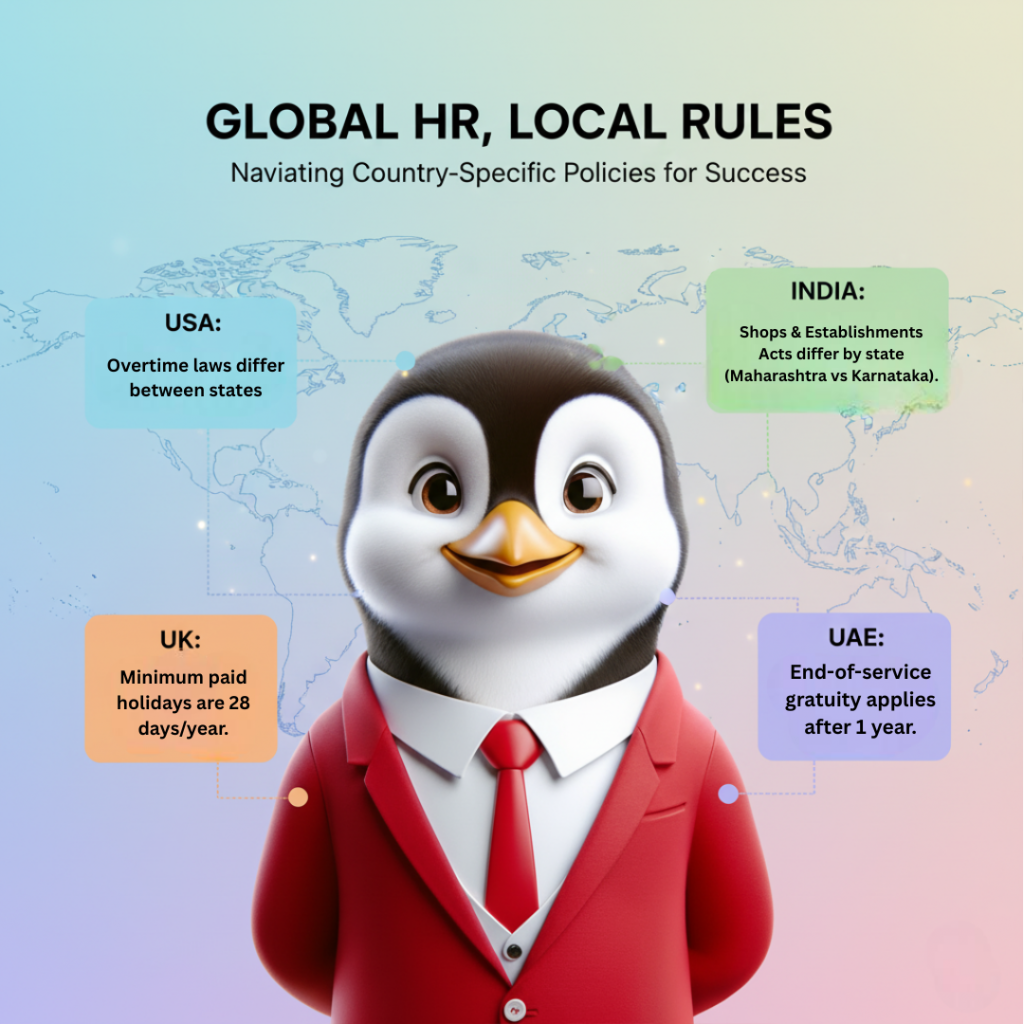
- USA: Overtime and wage laws vary across states. California, for instance, requires overtime pay after eight hours of work in a day, whereas federal law mandates it only after forty hours in a week. A one-size-fits-all policy could easily violate one or the other.
- India: Each state’s Shops & Establishments Act defines its own rules for leave, working hours, and record-keeping. Maharashtra allows 21 earned leaves annually, while other states may offer fewer or have different accrual systems.
- UK: Employees in the UK are legally entitled to 28 days of paid leave, including public holidays. Failing to include this in your policy can lead to penalties and employee complaints.
- UAE: Employees qualify for end-of-service gratuity after completing one year of continuous service. A policy that doesn’t clearly outline this benefit risks non-compliance with UAE labor law.
- Singapore: Under the Employment Act, workers are entitled to annual leave, rest days, and limits on overtime hours. A policy written for a different country may ignore these protections entirely.
These differences show why a global organization can’t rely on one universal document. Legal compliance isn’t optional — it’s mandatory.
Challenges of Maintaining Multi-Region HR Policies
Writing one set of HR policies is already a heavy task. Maintaining multiple versions for each jurisdiction makes it even more complex.
- Constant legal updates: Labor laws evolve frequently, requiring regular monitoring.
- Translation and terminology differences: Policies must be linguistically and culturally relevant.
- Administrative overload: HR teams often struggle to manually manage multiple drafts and updates.
- Risk of inconsistency: Without centralized oversight, local versions may drift from global standards.
Balancing compliance and consistency are a delicate process — and that’s exactly where AI steps in.
How AI Simplifies Location-Specific HR Policy Creation
With AI HR Policy Builders like HRTailor.AI, companies can automate the entire process. Instead of hiring consultants or maintaining multiple spreadsheets, AI generates policies that fit each jurisdiction instantly.
Here’s how it works:
- Detects Your Location Automatically
The system identifies your company’s region, whether you’re in London, Bangalore, or Dubai. It references the applicable labor laws and instantly sets the right legal framework.
- Aligns Policies with Local Law
Using real-time legal databases, AI incorporates jurisdiction-specific clauses. This ensures your policies meet every requirement — from minimum wages to parental leave and termination notice periods.
- Customizes for Company Size and Industry
A startup with 10 employees doesn’t need the same policies as a multinational enterprise. The AI adjusts policy details to match your company’s scale and sector.
- Generates Ready-to-Use Documents
Within minutes, HR managers receive polished, formatted policies that are compliant and professional. They can download them in Word or PDF formats for immediate rollout.
This combination of automation and legal intelligence drastically reduces the time and stress of compliance management.
Benefits of AI-Generated, Location-Specific HR Policies
- Time Efficiency: Generate compliant policies within minutes.
- Legal Accuracy: Policies reflect current local laws and updates.
- Scalability: Manage dozens of regional teams with consistent standards.
- Employee Confidence: Clear, location-specific policies build trust.
- Audit Readiness: Documentation stays up to date for legal inspections.
Whether you’re managing one branch or fifty, AI ensures your policies evolve as your organization grows.
Best Practices for Multi-Country HR Policy Management
Even with AI, effective policy management requires human oversight. Here are a few tips to ensure long-term success:
- Review annually: Schedule reviews to check for legal or organizational updates.
- Keep a global HR library: Store all location-specific policies in a centralized system.
- Communicate changes clearly: Notify employees promptly when a policy is revised.
- Encourage feedback: Local teams often spot compliance gaps before they escalate.
- Integrate AI tools: Combine automation with expert review for accuracy and tone consistency.
By merging technology with HR expertise, organizations can stay compliant and people-centric at the same time.
Conclusion
In a globalized workplace, location-specific HR policies are not optional they’re essential. Each region has its own rules, rights, and expectations. A single, universal policy might seem efficient, but it exposes companies to unnecessary risk.
With HRTailor.AI’s HR Policy Builder, creating legally aligned, localized policies is no longer a manual burden. It ensures compliance, builds employee confidence, and saves hours of HR effort.
Generate your location-specific policies today with HR Policy Builder compliance has never been this simple.


Frequently Asked Questions
Yes. One HRTailor.AI account can generate separate HR policies for every location or branch your company operates in.
Yes, policies can be customized for local languages to ensure accessibility and cultural fit.
The system updates regularly, so your generated policies always align with the latest regulations.
Absolutely. Even a five-person startup benefits from having legally compliant, localized policies.
How to Run Payroll Without a Full Payroll System.
How to Run Payroll Without a Full Payroll System. Introduction...
Read More
The HR Compliance Gaps That Quietly Turn Into Fines.
The HR Compliance Gaps That Quietly Turn into Fines. Introduction...
Read More
How to Optimize Your LinkedIn Profile So Recruiters Actually Find You.
How to Optimize Your LinkedIn Profile So Recruiters Actually Find...
Read More
How to Compare Job Offers by Take Home Pay Before You Say Yes.
How to Compare Job Offers by Take Home Pay Before...
Read More