
Health and Safety Policy: Employer
Responsibilities Explained
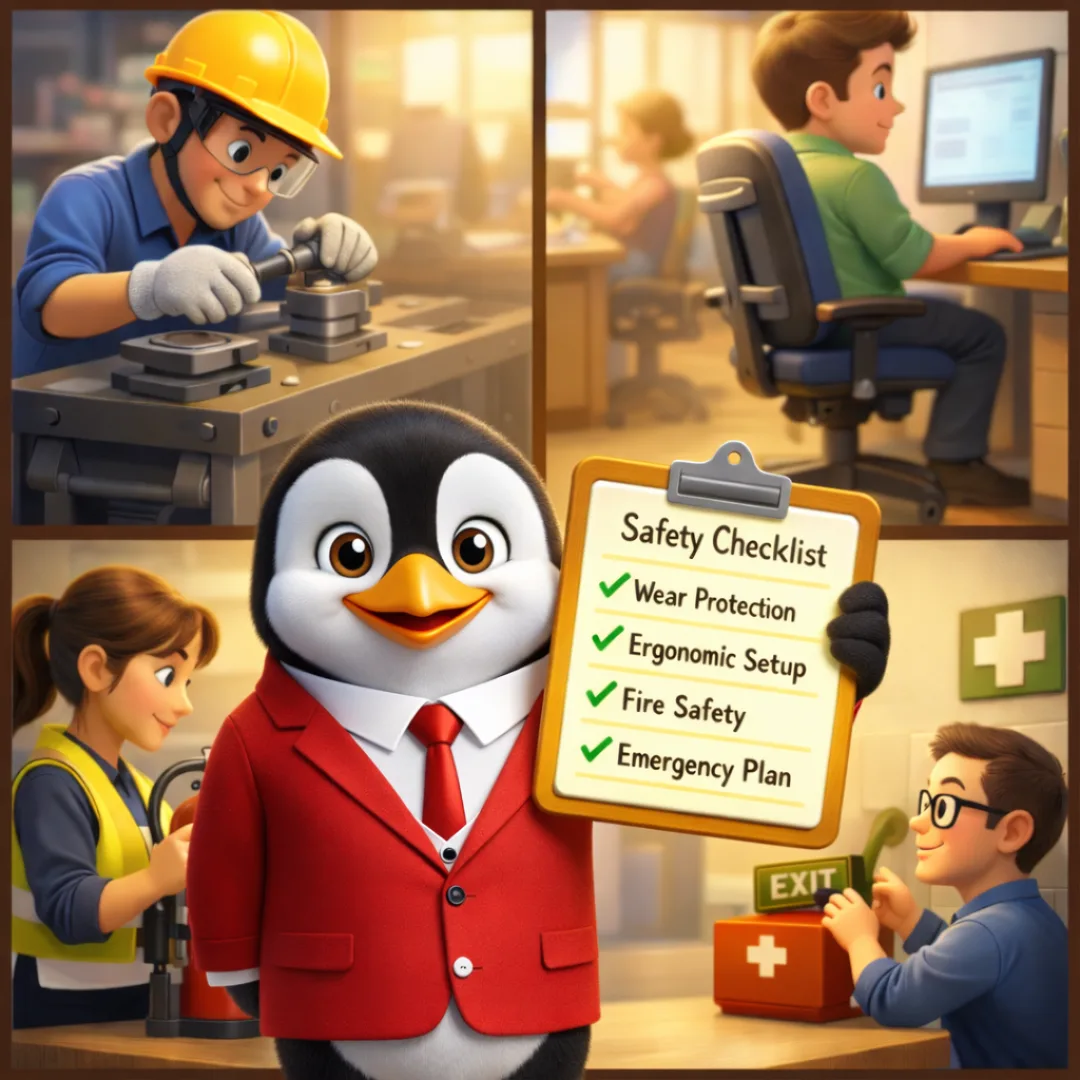
An employer’s core health and safety responsibility is to keep the workplace free from hazards that cause, or are likely to cause, injury or occupational disease, and to provide a working environment that is safe and without risk to health as far as is reasonably practicable. In India these duties now sit in the Occupational Safety, Health and Working Conditions Code, 2020 (OSH Code), in force since 21 November 2025. A health and safety policy is the document that shows how your organization meets them: who is responsible, how risks are assessed and controlled, how incidents are reported and how the system is reviewed.
This guide sets out the legal duties, a policy structure you can adapt, a practical risk assessment method, incident reporting rules, where the POSH Act fits, and a short note for employers outside India.
Employer duties under the OSH Code
Section 6 of the OSH Code lists what every employer must do. In plain terms:
- Keep the workplace free from hazards that cause or are likely to cause injury or occupational disease.
- Comply with the occupational safety and health standards declared under the Code and its rules.
- Provide free annual health examinations or tests to the classes of employees the government prescribes.
- Provide and maintain, as far as reasonably practicable, a safe working environment without risk to health.
- Dispose of hazardous and toxic waste, including e-waste, properly.
- Issue an appointment letter to every employee.
- Not charge employees for anything done or provided for safety and health, including medical examinations.
For factories, mines, docks, construction and plantations, the Code adds specific duties: safe plant and systems of work, safe handling and storage of substances, information, instruction, training and supervision, and safe access to and exit from every place of work.
The Code also covers welfare. The Ministry of Labour and Employment’s employer handbook summarizes it: cleanliness, ventilation, lighting, safe drinking water, separate toilets for men, women and transgender workers, first aid, washing facilities and rest areas, with a canteen required where 100 or more workers are employed and a crèche where more than 50 are employed. Registration under the Code applies to establishments with 10 or more employees.
Health examinations and safety committees
Who gets a free annual health check depends on the rules for your type of establishment. The central rules, for example, require free annual medical examinations for dock and construction employees who have completed 40 years of age, and the ministry’s FAQ notes that workers in hazardous processes and dangerous operations get pre-employment and periodic examinations irrespective of age, at intervals set by state rules. Check the rules that apply to you.
The government can require any establishment to set up a safety committee with at least as many worker representatives as employer representatives. Safety officers are mandatory in factories with 500 or more workers, hazardous-process factories with 250 or more, construction work with 250 or more and mines with 100 or more.
What employees must do
The Code places duties on employees too: take reasonable care of their own and others’ health and safety, follow the safety requirements, co-operate with the employer, report unsafe situations as soon as practicable and not misuse safety equipment. Employees also have a right to safety information and to raise concerns, and where they reasonably believe there is imminent danger of serious injury or death they can bring it to the employer’s notice and, at the same time, to the Inspector-cum-Facilitator. Your policy should say this plainly.
How to structure a health and safety policy
A good policy has three parts: a statement of intent, an organization section and an arrangements section.
| Section | What it covers |
|---|---|
| Statement of intent | Commitment to safe work, signed by the most senior person, with the date of the last review |
| Organization and responsibilities | Who is accountable at board level, who manages safety day to day, the role of supervisors, the safety committee and every employee |
| Risk assessment | How hazards are identified, how often assessments are reviewed and who signs them off |
| Safe systems of work | Procedures for higher-risk tasks: machinery, work at height, chemicals, electrical work, driving |
| Training | Induction, task-specific training, refreshers and records |
| Protective equipment | What is issued, free of charge, and how it is maintained |
| Health and welfare | Health examinations, first aid, drinking water, toilets, rest areas, ergonomics, mental well-being |
| Emergencies | Fire, evacuation, medical emergencies, drills and assembly points |
| Incident reporting | How to report accidents, near misses and dangerous occurrences, and who notifies authorities |
| Contractors and visitors | Induction, permits to work and supervision |
| Monitoring and review | Inspections, audits, indicators and the annual review |
Keep the policy short and readable, then attach procedures as annexures. Office and industrial settings need different arrangements; our guide to health and safety rules for offices and industrial sites covers both.
Risk assessment in five steps
- Identify hazards. Walk the site, read incident and near-miss records and ask employees what worries them. Include physical, chemical, electrical, ergonomic and psychosocial hazards.
- Decide who might be harmed and how. Consider new joiners, contractors, visitors, pregnant employees, night-shift workers and people working alone.
- Evaluate and control. Remove the hazard if you can; otherwise substitute, engineer it out, use procedures and training, and use protective equipment as the last line of defence.
- Record and communicate. Write down the main findings and controls, and tell the people affected.
- Review. Revisit after an incident, a process change, new equipment or at a fixed interval.
Example: a hypothetical 40-person office finds three main risks: trailing cables near desks, poor workstation set-up causing back complaints, and an untested fire alarm. Controls are cable management, a workstation self-check with adjustable chairs on request, and a monthly alarm test with a six-monthly evacuation drill. Each control has an owner and a date.
Where women work before 6 a.m. or after 7 p.m., the Code requires their consent and compliance with prescribed safety measures, so night transport and security should appear in the risk assessment.
Incident reporting: what must be notified
The Code requires employers to notify the prescribed authorities of:
- Any accident that causes death, or an injury that prevents the person from working for 48 hours or more immediately after the accident.
- Any dangerous occurrence of a prescribed kind, whether or not anyone is hurt, such as a fire, explosion, toxic release, crane or scaffold collapse.
- Any case of a notifiable occupational disease listed in the Code’s Third Schedule.
Timelines are short. Under the central rules, a fatal accident must be reported forthwith, an injury causing 48 hours or more of absence within twelve hours after those 48 hours are completed, and a listed dangerous occurrence within twelve hours. State rules may set their own forms and timelines, so put the exact steps for your location in the policy and name the person responsible.
Internally, record every incident and near miss, investigate the root cause rather than stopping at “human error”, and track corrective actions to closure. Accidents during the commute between home and work can also be treated as arising out of employment for compensation under the Code on Social Security, 2020, so make sure travel incidents reach HR.
Where POSH fits in
A safe workplace includes freedom from sexual harassment. The Sexual Harassment of Women at Workplace (Prevention, Prohibition and Redressal) Act, 2013 (POSH Act) remains in force separately from the Labour Codes. Employers with 10 or more employees must constitute an Internal Committee; smaller workplaces, and complaints against the employer, go to the Local Committee set up by the District Officer. Complaints are to be filed within three months, extendable by another three, and the inquiry completed within 90 days. Employers must also make staff aware of the law and run regular awareness and training.
Link your health and safety policy to a separate POSH policy rather than merging them: the procedures, committees and confidentiality rules are different.
Common mistakes in health and safety policies
- Copying a generic template that does not match the actual work or site.
- Naming roles but not people, so nobody owns a control.
- Treating protective equipment as the first control instead of the last.
- No contractor section, although principal employers must provide welfare facilities for contract labour.
- No review date, so the policy stays frozen after a change of premises or process.
- Still referring to the formerly Factories Act or other repealed laws instead of the OSH Code and current rules. See which HR policies to rewrite now that the Labour Codes are in force.
Related policies matter too. A drug and alcohol testing policy can support safety-critical roles, and our piece on how health and safety policies protect employees and employers covers the wider business case. To draft a first version you can adapt, the HRTailor.AI HR policy generator creates a structured, location-aware policy to edit and download.
A note for employers outside India
The structure above travels well, but the legal triggers differ. In Great Britain, every business must have a policy for managing health and safety, and it must be written down if there are five or more employees. In the United States, the federal workplace safety agency publishes recommended practices for safety and health programs built on management leadership, worker participation, hazard identification and control, training and continuous improvement. If you operate in several countries, keep one group framework and add a local annex for each country’s reporting rules.
Last reviewed: 26 October 2026. General information, not legal or tax advice.
Official sources
- Occupational Safety, Health and Working Conditions Code, 2020
- Occupational Safety, Health and Working Conditions (Central) Rules, 2026
- Ministry of Labour and Employment: Compliance Handbook for Employers under the Four Labour Codes
- Ministry of Labour and Employment: FAQ on the OSH&WC Code, 2020
- PIB: Overview of the Sexual Harassment of Women at Workplace Act, 2013 and SHe-Box
- Health and Safety Executive (UK): prepare a health and safety policy
- OSHA (US): recommended practices for safety and health programs
Related reading


Frequently Asked Questions
Employers are primarily responsible, but employees must follow safety guidelines.
Risk assessment, training, emergency procedures, and provision of safety equipment.
They ensure protection, reduce accidents, and promote well-being and confidence.

How to Create a Workplace Code of Ethics: A Practical Guide.
How to Create a Workplace Code of Ethics: A Practical...
Read More
How to Calculate Employee Attrition Rate: Formula and Examples.
How to Calculate Employee Attrition Rate: Formula and Examples. Understand...
Read More
What Is a Performance Improvement Plan (PIP)? Steps, Examples and Template.
What Is a Performance Improvement Plan (PIP)? Steps, Examples and...
Read More
The HR Compliance Gaps That Quietly Turn Into Fines
The HR Compliance Gaps That Quietly Turn into Fines Introduction...
Read More