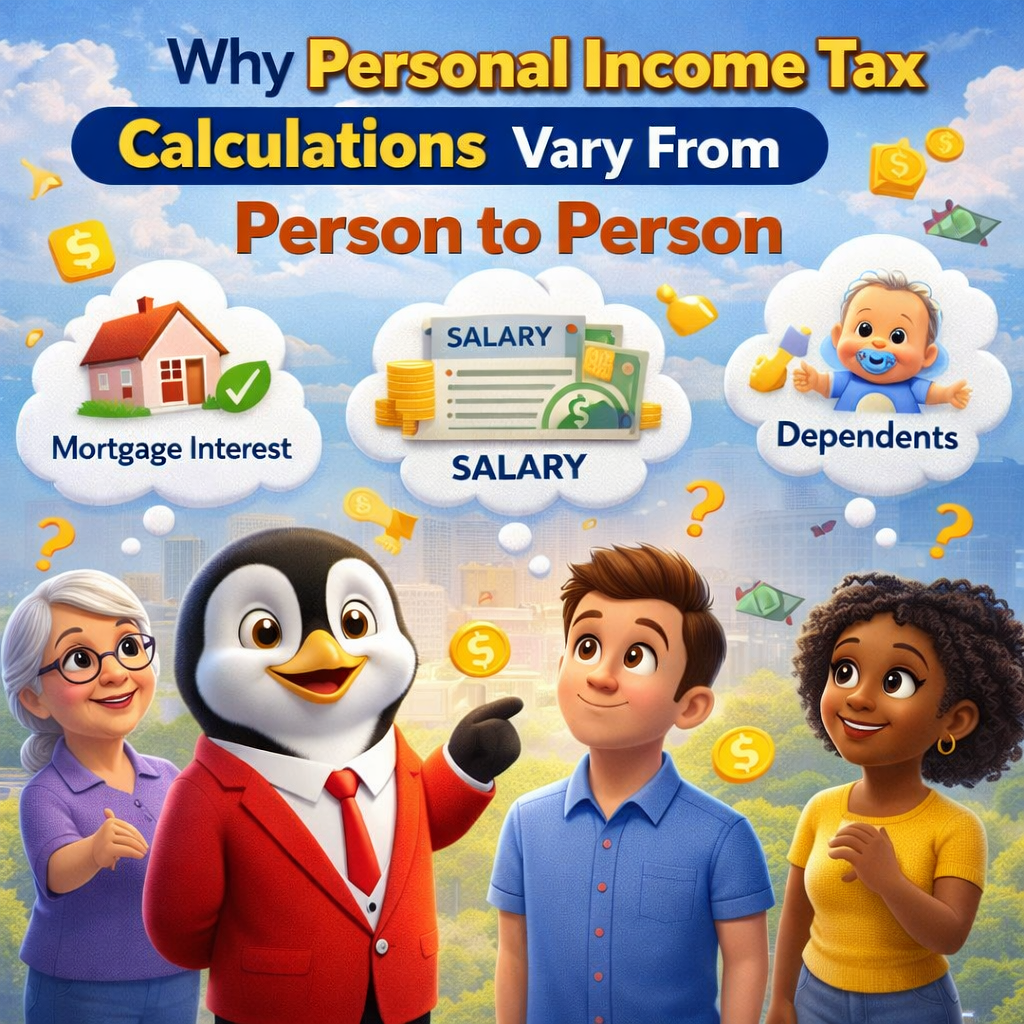
Have you ever compared paychecks with a coworker and wondered why the numbers don’t match despite similar salaries? It’s a common surprise. However, it’s also completely normal.
Personal income tax isn’t a one-size-fits-all formula. Instead, it’s shaped by your income sources, location, deductions, benefits, and life situation. So, even small differences like a change in benefits or a second income stream can shift your final tax and your take-home pay.
That’s also why people often use a personal income tax calculator when they’re budgeting, switching jobs, or planning a major financial decision. It’s not just about tax it’s about clarity.
Taxes are personal because your “taxable income” is personal
Many people think taxes are calculated on their salary alone. Yet your salary is only a starting point. What matters is taxable income— the portion of your income that remains after allowances, deductions, and adjustments are applied.
For example, two people can earn the same gross income, but one might contribute more to retirement, claim different deductions, or receive different benefits. As a result, their taxable income can differ, and so can their tax bill.
The biggest reasons tax differs from person to person
1) Your income type matters, not just the amount
Salary is only one kind of income. Many people also earn from:
Because these can be taxed differently, the “same income” can lead to different outcomes. Moreover, some income types may be taxed at special rates or handled separately in returns, depending on local rules.
2) Where you live can change everything
Location often impacts tax more than people expect. Depending on the country—or even the state, province, or city—different rates and rules may apply.
So, two people with identical salaries in two different locations can take home very different amounts. Therefore, location is one of the first things to consider when estimating net pay.
3) Your filing status and household situation affects tax
Your life situation influences how taxes work. For instance:
These details can change allowances or credits. Consequently, the tax you owe may fall—even if income stays the same.
4) Deductions and credits are not the same for everyone
Some people have deductions or credits that others don’t. Common examples include:
-
Retirement contributions
-
Education-related expenses
-
Health expenses (in some systems)
-
Home ownership or mortgage-related items (in some systems)
-
Donations and charitable contributions
Even when deductions are small, they can add up over a year. In addition, credits can reduce tax more directly than deductions in many systems.
5) Benefits and payroll choices affect take-home pay
Your paycheck can change due to workplace choices, such as:
Because these can reduce taxable wages, the tax withheld can drop too. Meanwhile, someone who opts out of these benefits may see higher taxable wages and higher withholding.
Withholding vs actual tax can look different
Another reason tax feels inconsistent is that paycheck withholding is often an estimate. Employers or payroll systems withhold based on the information you provide and the rules they follow. Then, at filing time, the final calculation is done.
So, your withholding might be slightly high or slightly low during the year. As a result, refunds or balances due can happen even when nothing “went wrong.”
This is exactly where a personal income tax calculator can help: it gives you a practical estimate so you can spot big gaps early and adjust.
Life changes can shift your tax even if your job doesn’t
Taxes often change because life changes. For example:
-
You start a side gig
-
You move to a new location
-
You get married or have a child
-
You begin investing
-
You change retirement contribution levels
Even if your salary stays the same, these shifts can change taxable income, credits, and withholding assumptions. Therefore, reviewing your situation once or twice a year is a smart habit.
A simple way to understand why your net pay changes
If you want a clean mental model, think in layers:
-
Gross income (everything you earn)
-
Adjustments and deductions (what reduces taxable income)
-
Tax rates and brackets (how taxable income is taxed)
-
Credits (what reduces tax directly, where available)
-
Withholding and payments (what was already collected)
-
Final result (refund, balance due, or even)
When you see it like this, the variation makes sense. After all, each person’s layers look different.
How calculators fit into real-life decisions
Most people don’t want to manually run tax scenarios. They just want quick clarity, such as:
-
“What will I take home if my salary increases?”
-
“How does a bonus affect my month?”
-
“What happens if I add a side income?”
-
“How does moving change my net pay?”
In these moments, an income tax calculator can act like a planning tool. And when the focus is personal scenarios—income, location, deductions, and household details a personal income tax calculator becomes even more useful because it’s designed to reflect differences instead of assuming everyone is the same.
Use HRTailor.AI Income Tax Calculator for quick, practical estimates
If you want an easier way to model “what-if” scenarios and understand why take-home pay changes, Try HRTailor.AI – Income Tax Calculator. HRTailor.AI is built in India, and our tools are designed for global users so you can estimate outcomes clearly, compare scenarios faster, and plan with more confidence.