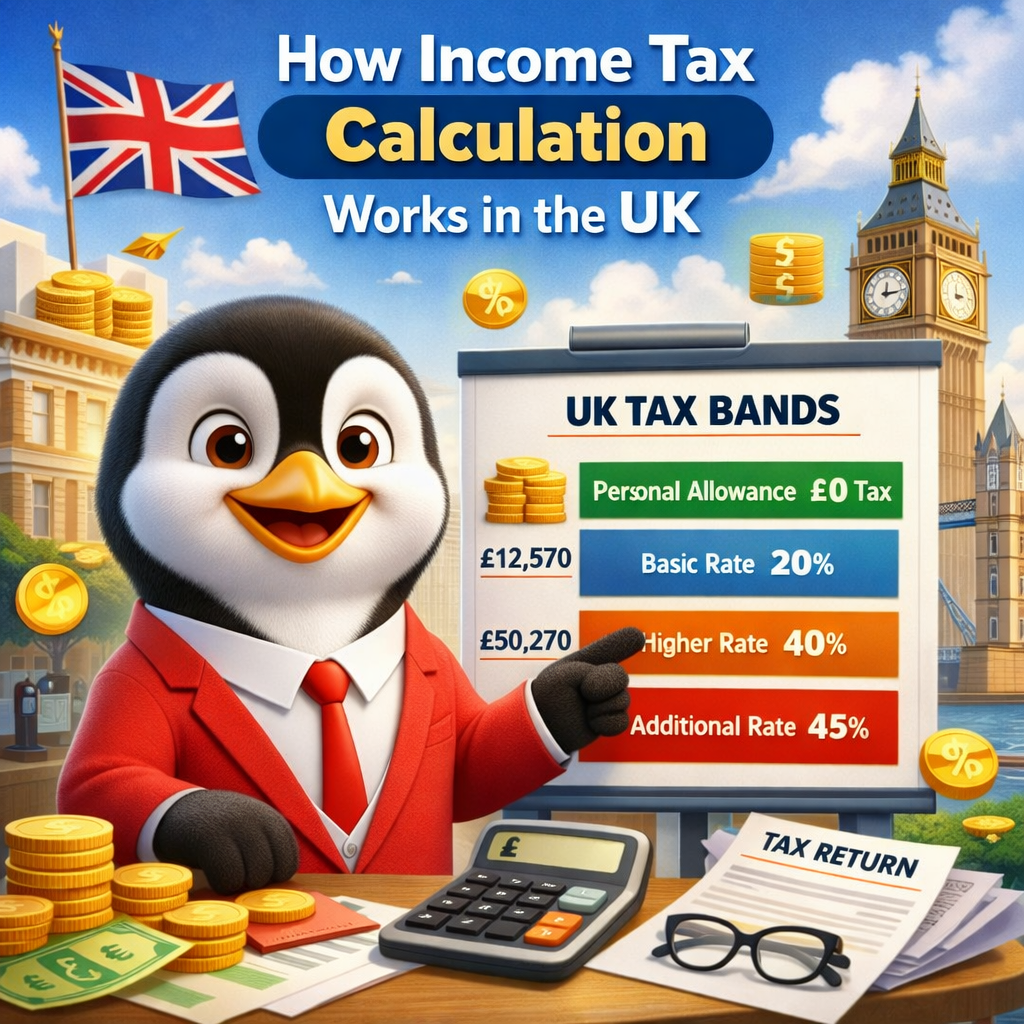
Income tax in the UK can look confusing at first. However, once you understand the steps, it becomes much easier to follow. Your tax isn’t calculated on your full salary in one go. Instead, it’s calculated in layers, using allowances and tax bands.
That matters because many people assume a higher tax band means all their income is taxed at that rate. In reality, only the portion that falls into each band is taxed at that band’s rate. So, your final tax bill is usually more predictable than it looks.
This guide explains how the calculation works, what affects it, and how most people estimate their take-home pay using an UK income tax calculator.
The building blocks of UK income tax
1) The tax year
The UK tax year runs from 6 April to 5 April. Your income and allowances are assessed within that period.
2) Personal Allowance
Most people can earn a standard Personal Allowance before paying income tax. For the 2025–26 tax year, the standard allowance is £12,570.
If your adjusted net income goes above £100,000, your Personal Allowance is reduced by £1 for every £2 over that threshold. It falls to £0 at £125,140.
3) Taxable income
Once the Personal Allowance is applied, what remains is your taxable income. That taxable portion is then split across tax bands.
UK income tax bands: England, Wales, and Northern Ireland
For most taxpayers in England, Wales, and Northern Ireland, the main bands are:
-
20% basic rate up to £37,700 (after your allowance)
-
40% higher rate from £37,701 to £125,140
-
45% additional rate above £125,140
Important: these bands apply to taxable income, not total salary.
Scotland is different (and it catches people out)
If you live in Scotland, income tax rates and bands on non-savings, non-dividend income are set differently. So the slices of income are taxed at different percentages compared to the rest of the UK.
Because of that, two people earning the same salary—one in Scotland and one in England—may pay different income tax.
Step-by-step: how your income tax is calculated
Here’s the simple flow most calculations follow:
Step 1: Add up your taxable income sources
Usually this includes employment income, some pensions, and some benefits. It may also include rental income and self-employment profits.
Step 2: Subtract allowances
For many people, the biggest one is the Personal Allowance. If your income is high, remember it may be reduced.
Step 3: Apply tax bands to the remaining amount
Your taxable income is split into “slices.” Each slice is taxed at the rate for that band.
Step 4: Factor in deductions collected through PAYE
If you’re employed, tax is often collected automatically through PAYE. Your tax code influences how much is taken.
A practical example (kept simple)
Imagine someone in England earns £40,000 from employment.
-
Personal Allowance: £12,570
-
Taxable income: £40,000 − £12,570 = £27,430
-
This falls within the basic rate band, so it’s taxed at 20% (on that taxable portion).
That’s the core idea: allowance first, bands second.
Now, if income rises above the basic band, the extra portion is taxed at the higher rate – while the earlier portion remains taxed at the lower rate.
This is also why many job seekers and employees like using an uk income tax calculator before accepting a new offer, negotiating salary, or switching roles.
What can change your tax calculation
Even with the same salary, take-home pay can shift. Here are common reasons:
Your tax code changes
Your tax code can change due to benefits in kind, underpaid tax from a prior year, or changes in allowances.
You have multiple jobs or pensions
Income from different sources can be taxed differently depending on how your allowance is applied.
You earn above £100,000
The Personal Allowance taper can create a higher effective rate in that range.
Dividends and savings have their own rules
Dividend income has an allowance and separate tax rates, which can affect the overall picture.
Where an online calculator fits in
A calculator is useful because it turns rules into an estimate quickly. Most people don’t want to manually slice income into bands every time they compare two job offers.
A good uk income tax calculator typically helps you:
-
Estimate take-home pay from gross salary
-
Account for Personal Allowance rules
-
Show band-by-band breakdown clearly
-
Compare scenarios (raise, bonus, new job)
That said, it’s still an estimate. Your final tax depends on your exact circumstances and HMRC records.
Use HRTailor.AI Income Tax Calculator to simplify estimates
Whether you’re based in the UK or managing UK payroll and take-home estimates from anywhere, the HRTailor.AI Income Tax Calculator helps you model income tax quickly and clearly. HRTailor.AI is built in India, but designed for global users – so you can estimate UK take-home pay with confidence. especially when you’re planning changes.