How HR Teams Decide What Health Insurance Coverage Employees Really Need
Introduction
Choosing employee benefits can feel like trying to hit a moving target. Costs rise, expectations change, and different teams need different things. Still, HR is expected to deliver a plan that feels fair, competitive, and practical.
So, how do HR teams decide what coverage employees really need?
It usually comes down to one thing: balancing employee needs with business reality—without making the process confusing. When done well, benefits improve retention, reduce stress, and strengthen trust. When done poorly, employees feel unheard, and HR gets stuck answering the same questions again and again.
In this guide, we’ll walk through a simple, professional framework HR teams use to build health benefits that actually fit the workforce. Along the way, we’ll cover medical plans, add-ons like dental insurance coverage, and how to make decisions that employees can understand.
Start With the Workforce: Who Are You Covering?
Before comparing plans, HR teams look at the people the plan is meant to support. This step is often skipped, yet it’s the most important.
Key workforce factors include:
-
Age mix (early-career vs. mid-career vs. senior employees)
-
Family status (single, married, dependents)
-
Work setup (on-site, hybrid, remote)
-
Locations (different cities may have different provider networks)
-
Typical health needs (general wellness vs. chronic care support)
For example, a younger workforce may care more about affordable monthly premiums and wellness perks. Meanwhile, employees with families might prefer stronger coverage for hospital stays, maternity, or pediatric care.
Define the Benefits Goal: What Should the Plan Achieve?
Next, HR clarifies the “why” behind the benefit design. Without clear goals, the plan becomes a patchwork of features.
Most HR teams aim for a mix of these goals:
-
Retention: Benefits that reduce job-switching
-
Attraction: A plan that feels competitive in hiring
-
Affordability: Costs that won’t explode over time
-
Clarity: Employees understand what’s included
-
Fairness: Coverage fits different life stages
Once goals are set, it becomes easier to choose what to include and what to avoid.
Use Employee Input Without Turning It Into Chaos
Surveys help, but only when they’re structured.
Instead of asking, “What benefits do you want?” HR teams ask targeted questions like:
-
Which medical expenses are most common for you?
-
Do you prefer lower monthly cost or lower out-of-pocket costs?
-
Do you visit the dentist regularly?
-
Which matters more: broad provider network or lower cost?
Then HR pairs survey results with actual usage patterns from the insurer or broker (where possible). That combination creates a more accurate picture.
Also, it prevents decisions based on the loudest voices in the company.
Focus on the Core: Medical Coverage Comes First
When employees evaluate benefits, they usually start with medical coverage. That’s why HR spends the most time here.
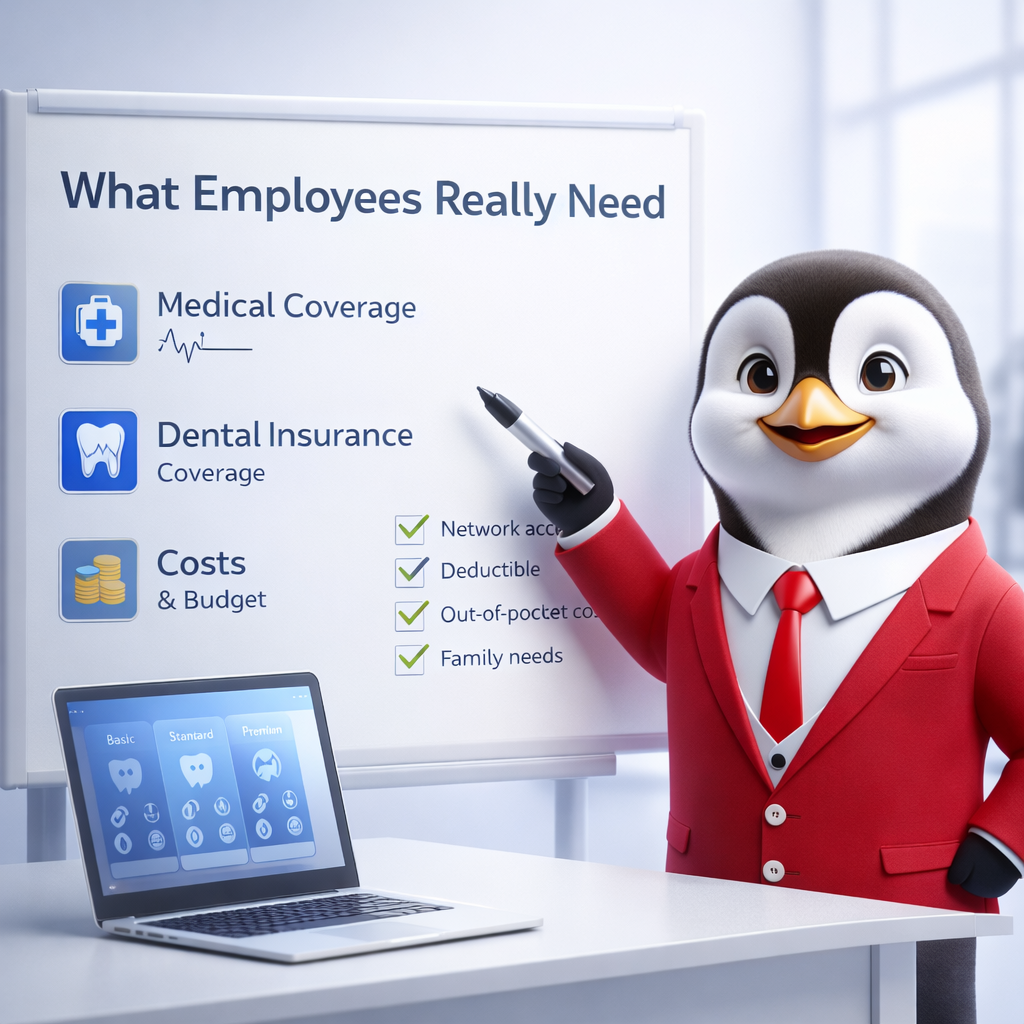
To decide the right medical plan structure, HR compares:
-
Premium cost (what the company and employee pay monthly)
-
Deductibles (what employees pay before coverage kicks in)
-
Co-pays and co-insurance (cost per visit or percentage paid)
-
Network size (access to hospitals and specialists)
-
Prescription support (generic vs. brand coverage)
-
Emergency and hospitalization terms
The goal is to make the plan usable—not just presentable.
A plan can look “premium” on paper. However, if employees avoid using it because it’s too expensive at the point of care, it won’t feel like a real benefit.
That’s why health insurance for employees is often designed around a “sweet spot” between monthly cost and real-world usability.
Decide on Add-Ons: Why Dental Often Matters More Than HR Expects
Medical coverage is the base. Yet add-ons can strongly impact satisfaction.
One of the most valued add-ons is dental insurance coverage. It’s simple, predictable, and used more regularly than many other benefits.
HR typically evaluates dental based on:
-
Preventive care (cleanings, check-ups, x-rays)
-
Coverage for fillings and root canals
-
Major procedures (crowns, bridges, extractions)
-
Waiting periods and annual limits
-
Provider access and claim simplicity
Even better, dental benefits often feel “visible.” Employees can use them annually, which increases perceived value.
Also, a solid dental plan reduces out-of-pocket spending for common needs, which builds goodwill quickly.
Balance Cost With Coverage: The “3 Plan Option” Strategy
Many companies offer one plan and hope it fits everyone. That rarely works.
Instead, HR teams often use a three-tier approach:
-
Basic Plan: Lower premium, higher deductible
-
Standard Plan: Balanced premium and coverage
-
Premium Plan: Higher premium, lower out-of-pocket costs
This gives employees choice without creating confusion.
It also helps HR manage budgets. For example, the company can contribute a fixed amount, while employees choose the plan level they prefer.
This model supports fairness because different life stages require different coverage patterns.
Check Equity: Is the Plan Fair Across Levels and Locations?
A plan can be generous, yet still feel unfair if it impacts groups differently.
HR checks:
-
Are junior employees priced out due to payroll deductions?
-
Do remote employees have network access where they live?
-
Are families supported with dependent options?
-
Are part-time or contract workers addressed clearly?
Even small changes—like adjusting employer contribution percentages—can improve fairness dramatically.
Make It Understandable: Benefits Should Not Feel Like a Puzzle
Employees don’t want a 40-page document full of complex terms. They want quick clarity.
So HR teams typically create:
-
A one-page plan comparison sheet
-
Simple “what you pay” examples (doctor visit, dentist visit, emergency)
-
Clear FAQs for common situations
-
A short enrollment guide with deadlines and steps
When benefits are explained clearly, fewer tickets hit HR. Also, employees feel more confident choosing a plan.
Review and Improve Each Year Using Real Signals
Benefits planning is not a one-time decision. It’s an annual cycle.
HR reviews:
-
Enrollment distribution (which plan employees choose)
-
Claims trends and high-cost drivers
-
Employee feedback and complaints
-
Broker insights and market comparisons
-
Vendor performance (support quality, turnaround time)
Then the plan is adjusted. Sometimes that means improving coverage. Other times, it means simplifying options or improving communication.
Either way, the best benefits programs evolve with the workforce.
Conclusion: Coverage Should Fit Real Life, Not Just a Spreadsheet
When HR designs benefits well, it feels effortless to employees. Yet behind the scenes, a smart framework is doing the work: understand the workforce, set clear goals, compare plan structures, add the right extras, and explain everything simply.
That’s the real difference between a plan employees tolerate and a plan employees value.
If you want help drafting benefits FAQs, creating a plan comparison checklist, or aligning coverage decisions with local requirements, you can use AskHRTailor.AI inside HRTailor.AI. It helps HR teams get clear, structured answers faster—especially when policies and benefits questions get complex.


Frequently Asked Questions
The best option depends on your workforce needs and budget. Most HR teams aim for a plan that balances monthly premiums with affordable out-of-pocket costs, plus a strong provider network.
Yes, in many companies dental is a high-value add-on. It supports preventive care and reduces common employee expenses, which improves satisfaction.
They usually compare market benchmarks, budget limits, and pay-level fairness. A common approach is a fixed employer contribution, with optional plan upgrades paid by employees.
Because real usability matters. High deductibles, limited networks, or confusing claim processes can make employees feel unsupported—even if the plan appears comprehensive.
Most companies review benefits annually. However, fast-growing teams or multi-location companies may review them more often due to changing needs and cost trends.
Job Contract Agreement Explained With Key Clauses and Examples
Job Contract Agreement Explained With Key Clauses and Examples Introduction...
Read More
What HR Teams Should Check Before Using a Sample Offer Letter
What HR Teams Should Check Before Using a Sample Offer...
Read More
How Salary Taxes Are Calculated on Your Payslip
Your pay slip can look like a mini...
Read More
End of Employment Letters: Resignation, Termination, and Closure Explained
End of Employment Letters: Resignation, Termination, and Closure Explained Introduction...
Read More