Introduction
Employee exits look simple on paper. However, in real operations, they involve handovers, asset returns, access closure, payroll checks, and final approvals.
Because multiple teams join the process, timelines often slip. As a result, companies face avoidable follow-ups, unhappy ex-employees, and messy records.
A clear offboarding workflow solves most of these issues. It helps you issue the right documents at the right time, while keeping compliance and consistency in place.
Why HR documentation slows teams down (and where mistakes happen)
Documentation slows down because it depends on people, not a system. For example, HR waits for a manager’s clearance, finance waits for recovery updates, and IT waits for confirmation to disable access. Meanwhile, employees keep asking for exit letters.
Where mistakes happen most often
Most delays and errors come from repeatable gaps, such as:
-
Using an old template from email or a shared drive
-
Mixing up dates (resignation date vs last working day)
-
Missing clearance updates (assets, loans, advances, notice buyout)
-
Inconsistent wording across letters and emails
-
Manual copy-paste of names, IDs, and roles
-
No clear “final approver,” so the task stays stuck
Therefore, even a small exit can take days longer than it should.
What a relieving letter confirms (simple definition)
A relieving letter is a formal confirmation that the employee has been released from their duties and responsibilities from a specific date.
Many founders search for relieving letter from employer because they want to understand when it is issued and what it proves. In practice, it helps the employee during background checks and joining formalities at the next company.
When companies should issue a relieving letter
Most companies issue it only after the exit is “closed” internally. That means key steps are completed and documented.
A practical timing rule is: issue the relieving letter on (or immediately after) the last working day—once clearances are confirmed.
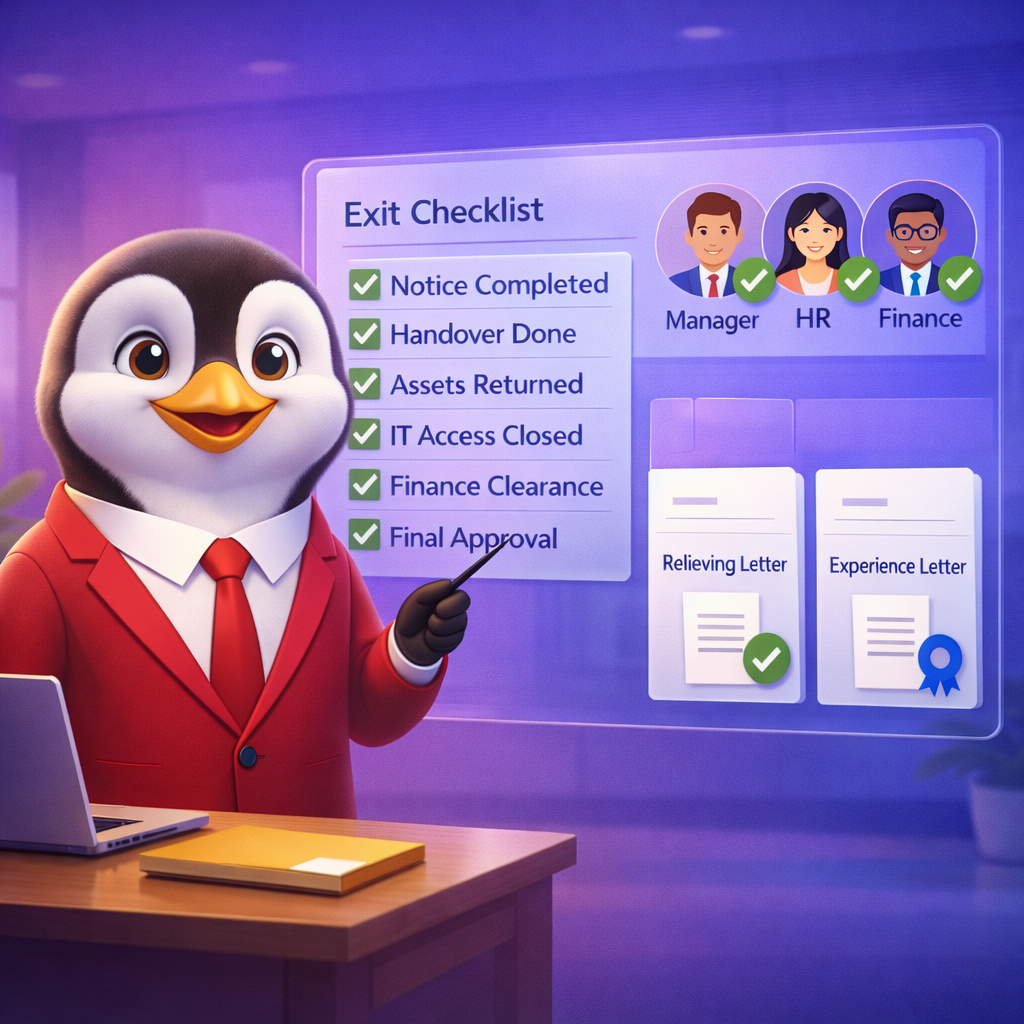
Here are the typical checkpoints:
-
Notice period completed (or buyout approved)
-
Handover completed (projects, passwords, documentation)
-
Company assets returned (laptop, ID card, headset, access card)
-
IT access closure initiated (email, tools, device access)
-
Finance clearance completed (pending dues or recoveries noted)
-
Final approver sign-off recorded (HR + manager, and finance if needed)
However, if a step remains pending (like asset return), you should first follow your policy. In many teams, the letter goes out only after closure to avoid disputes later.
What to include in the letter
Keep the content factual and short. Also, avoid personal comments.
Include:
-
Employee full name and employee ID (if used)
-
Department and designation (optional but helpful)
-
Last working day / relieving date
-
A clear statement that the employee is relieved from duties
-
Company name, date, and authorized signatory
Don’t include: salary details, performance notes, or internal reasons beyond what your policy requires.
Why timing matters for compliance and reputation
Timely documentation reduces friction. It also reduces risk.
When letters are delayed:
-
Employees escalate to founders or senior leaders
-
Background verification becomes harder
-
Teams waste time digging for records
-
Disputes about last working day become more likely
On the other hand, a consistent offboarding process builds trust. Even if someone leaves quickly, they still remember how professional the exit felt.
How AI-powered workflows reduce delays and errors
AI works best when it supports a clear process. So, the goal is not “AI writing letters,” but AI running the workflow correctly.
A strong AI workflow usually does five things:
1) Starts with structured inputs (not free-text emails)
Instead of “Please prepare the letter,” the system collects details like letter type, work mode, location, industry, company type, and employee type. That improves accuracy and reduces back-and-forth.
2) Uses approved templates and consistent formatting
When templates stay consistent, the output stays consistent. Also, it becomes easier to review and approve documents at scale.
3) Applies location-specific language where needed
Local rules and expectations vary by country and even by state. Therefore, workflows that adjust letters by region reduce compliance mistakes for multi-location teams.
4) Produces ready-to-share outputs quickly
Teams move faster when they can download documents in standard formats (PDF for sharing and Word for edits). As a result, leaders spend less time fixing formatting.
5) Keeps a workflow checklist and clear handoffs
Workflows make offboarding repeatable. They map tasks across HR, managers, finance, and IT, which reduces “who is waiting on whom” confusion.
A simple offboarding workflow you can copy
Use this step-by-step flow to issue the relieving letter on time:
Step 1: Open an exit request
Capture resignation date, proposed last working day, notice terms, and reporting manager.
Step 2: Trigger a clearance checklist
Include: handover, assets, IT access closure, finance clearance, and approvals.
Step 3: Lock the last working day
Once HR and the manager confirm it, freeze the date to prevent later confusion.
Step 4: Generate draft documents automatically
Create drafts for relieving letter, experience letter (if applicable), and full & final communication based on your policy and inputs.
Step 5: Route approvals in order
Manager → HR → Finance (if needed). Meanwhile, send reminders so tasks don’t stall.
Step 6: Issue and store
Share the final letter and store it in a central folder with version history.
Quick checklist for founders and ops leads
If you want a “fast and safe” system, use this checklist:
-
 One standard template set
 -
One owner for the process (HR/ops)
-
Clear definitions of dates
-
Documented clearance steps
-
Approval flow with reminders
-
Central storage + audit trail
Even if your team is small, this structure prevents repeated confusion later.
Conclusion
Relieving letters should not depend on memory, manual drafting, or who is available that day. Instead, they should follow a clear offboarding checklist, so the letter is issued on time, with correct dates and clean records.
Tools like HRTailor.AI can help by collecting structured details (like location, employee type, and letter category), generating consistent documents in downloadable formats, and reducing rework through a guided workflow based on your inputs.
Try HRTailor.AI to streamline your HR letters and offboarding documentation.


Job Contract Agreement Explained With Key Clauses and Examples
Job Contract Agreement Explained With Key Clauses and Examples Introduction...
Read More
What HR Teams Should Check Before Using a Sample Offer Letter
What HR Teams Should Check Before Using a Sample Offer...
Read More
How Salary Taxes Are Calculated on Your Payslip
Your pay slip can look like a mini...
Read More
End of Employment Letters: Resignation, Termination, and Closure Explained
End of Employment Letters: Resignation, Termination, and Closure Explained Introduction...
Read More