Introduction
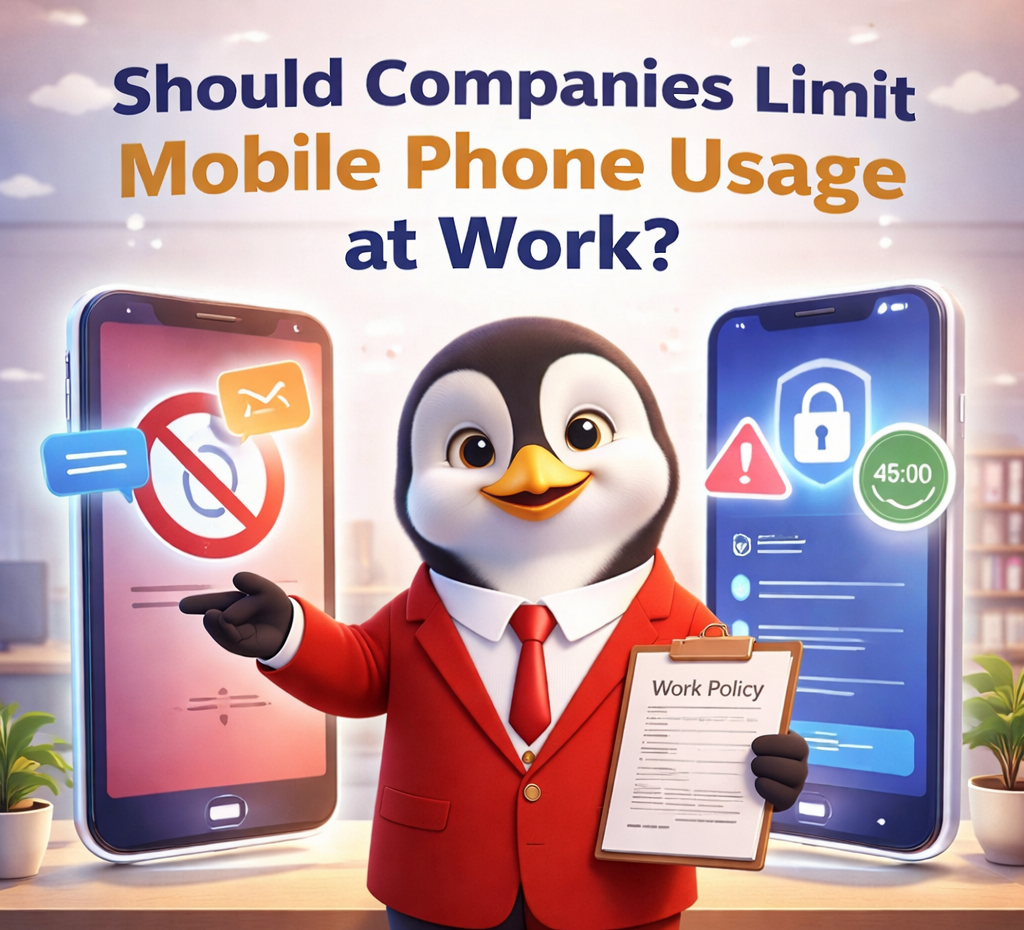
Mobile phones are no longer just personal devices—they are deeply woven into how people communicate, work, and stay connected. For employers and HR leaders, this raises an important question: should organisations limit mobile phone usage at work, or adapt to it? The answer is rarely black and white.
A thoughtful approach to mobile phone usage at workplace is not about restriction alone. It is about defining boundaries that protect productivity, confidentiality, and workplace discipline—without ignoring modern work realities.
Why This Question Matters More Than Ever
Unlike earlier years, mobile phones today serve multiple roles:
-
Work communication tools
-
Access points to company data
-
Emergency contact devices
-
Personal productivity aids
Without clear direction, managers often apply their own judgement, leading to inconsistency and confusion. HR teams, therefore, must decide whether mobile usage should be guided by informal norms or governed by a documented policy framework.
This decision directly impacts productivity, workplace culture, and even legal exposure.
Productivity vs. Presence: The Real Employer Dilemma
One of the biggest concerns employers raises is reduced focus. Constant notifications, social media access, and personal calls can fragment attention—especially in roles that require concentration or customer interaction.
At the same time, completely banning mobile phones may:
This is why organisations evaluating mobile phone usage at workplace must look beyond extremes and focus on role-based practicality.
When Limiting Mobile Phone Usage Makes Sense
From an HR governance perspective, limits are often justified when:
-
Employees handle sensitive or confidential information
-
Safety-sensitive roles are involved
-
Customer-facing professionalism is critical
-
Operational accuracy is non-negotiable
In such environments, structured limits protect not just productivity, but also reputation and compliance. The key is ensuring that restrictions are clearly explained and consistently applied.
Situations Where Flexibility Is More Effective
Not all roles require strict controls. In knowledge-based or hybrid environments, controlled flexibility may actually improve performance.
Allowing reasonable personal use:
For employers, the goal is not constant supervision, but clear expectations. This is where documented guidance becomes more effective than informal instructions.
Why Informal Rules Are Risky for HR
Relying on “common sense” or verbal instructions can create unintended risks:
-
Inconsistent enforcement across teams
-
Perceived bias in disciplinary action
-
Lack of documentation during disputes
-
Difficulty justifying decisions during audits
A defined approach to mobile phone usage at workplace ensures that HR decisions are supported by policy—not personal judgement.
The Role of HR in Defining Boundaries
HR teams are uniquely positioned to balance operational needs with employee experience. Instead of asking “Should phones be allowed?”, the better question is “Under what conditions should phone use be limited?”
This includes defining:
-
Acceptable use during work hours
-
Restricted zones or situations
-
Expectations during meetings or client interactions
-
Consequences for misuse
Many HR leaders simplify this process by using structured drafting frameworks such as the HRTailor.AI Policy Builder, which helps convert business concerns into clear, compliant policy language without starting from scratch.
Communication Is as Important as the Rule Itself
Even well-designed rules can fail if communication is poor. Employees are more likely to respect limits when:
-
The rationale is clearly explained
-
Expectations are written, not assumed
-
Policies are easy to access
-
Managers are aligned in enforcement
Transparent communication shifts the narrative from control to clarity.
Reviewing Limits as Work Culture Evolves
Workplaces today are dynamic. Hybrid work, remote teams, and digital collaboration continue to reshape norms.
HR leaders should periodically reassess:
-
Whether limits remain relevant
-
If technology usage patterns have changed
-
Whether policies reflect current work realities
A flexible review approach ensures that limits support productivity rather than restrict progress.
Conclusion
Limiting mobile phone usage at work is not about saying “no” to technology—it is about saying “yes” to focus, fairness, and professionalism. For employers, the real challenge lies in defining boundaries that align with business needs while respecting modern work culture.
When approached thoughtfully, mobile phone usage at workplace policies become tools for clarity rather than control. Clear rules, consistent application, and regular review allow organisations to maintain productivity without compromising trust.