Introduction
HR letters have evolved far beyond simple paperwork. They are now official, legally binding records that protect both employers and employees. Every stage of employment — from hiring to exit — requires clear, compliant communication.
In 2026, companies face increasing legal scrutiny, hybrid workforce challenges, and multi-country operations. Amid these complexities, HR letters act as anchors of accountability. A single missing clause or outdated format could lead to penalties or disputes. That’s why employers must understand exactly which HR letters they need — and how to create them quickly and correctly.
Why HR Letters Matter More Than Ever
HR letters serve as the backbone of any employer-employee relationship. They don’t just formalize actions; they establish trust, clarity, and compliance.
- Ensures Legal Compliance: Each HR letter aligns with local labor laws, reducing the risk of lawsuits.
- Documents Employee Lifecycle: From onboarding to resignation, every stage is formally recorded.
- Strengthens Employer Brand: Professionally written letters reflect reliability and organizational maturity.
- Prevents Disputes: Written communication prevents misunderstandings during promotions, terminations, or appraisals.
- Saves Time: Having standardized, ready-to-use letters speeds up HR operations significantly.
In short, HR letters are the invisible infrastructure that keeps a company’s people processes running smoothly.
Must-Have HR Letters in 2026
Every employer — whether running a small startup or a multinational organization — needs a complete set of HR letters. These documents not only ensure compliance but also create transparency and professionalism in every interaction.
Let’s break down the key HR letters every employer must have:
Offer & Appointment Letters – Setting the Foundation
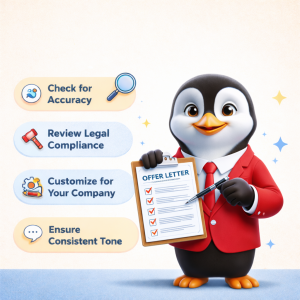
These are the first formal documents an employee receives. Offer letters outline salary, designation, and joining terms, while appointment letters confirm employment legally.
- Why it matters: Defines employment terms and protects both parties.
- AI advantage: Add jurisdiction-specific clauses automatically, such as at-will disclaimers for the USA or Shops & Establishments compliance for India.
Probation & Confirmation Letters – Defining Regularization
Probation letters clarify the duration and conditions of the trial period. Confirmation letters officially mark the transition to permanent status.
- Why it matters: Establishes employment continuity and clarifies rights after probation.
Promotion & Increment Letters – Recognizing Growth
These letters communicate salary hikes, title changes, or new responsibilities.
- Why it matters: Prevents miscommunication regarding new pay structures or designations.
- AI advantage: Ensure salary updates are reflected accurately across regions, complying with minimum wage or statutory limits.
Warning & Disciplinary Letters – Handling Misconduct Professionally
Every company faces performance or conduct issues occasionally. Warning letters serve as formal documentation before any further action is taken.
Why it matters: Protects the company during disciplinary cases by showing that due process was followed.
AI advantage: Provides neutral, legally sound language that avoids bias or risk.
Termination & Relieving Letters – Ending Employment Correctly
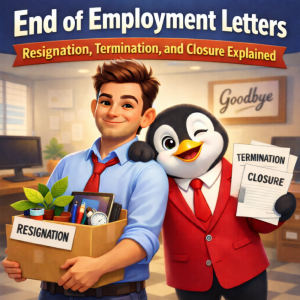
Ending an employment relationship requires care and compliance. Termination letters must clearly state reasons, notice periods, and final settlements. Relieving letters confirm that the employee has completed all formalities.
- Why it matters: Prevents legal backlash or disputes post-exit.
- AI advantage: Auto-generates termination clauses compliant with local laws — for instance, gratuity inclusion in India or at-will employment references in the US.
Experience Letters – Validating Employee History
These letters summarize an employee’s role, tenure, and achievements. They’re vital for future employment verification.
- Why it matters: Builds goodwill and maintains a professional reputation.
Together, these letters form the foundation of compliant HR documentation.
How HR Letters Differ Across Countries
Employers operating in multiple regions face complex compliance landscapes. What’s acceptable in one country might be illegal in another. Here’s how AI helps bridge those differences:
India → Exit letters must include gratuity and PF details as per the Shops & Establishments Act.
USA → Offer letters must carry at-will employment disclaimers and equal employment opportunity clauses.
UAE → Termination letters must mention end-of-service benefits.
UK → Probation and termination letters must align with statutory notice periods and worker rights.
AI tools like HRTailor.AI simplify this by auto detecting the company’s location and embedding the correct legal language. No guesswork — just accuracy.
How HRTailor.AI Helps Employers
Instead of relying on static templates or expensive consultants, employers can now use AI HR letter generation to draft precise, law-compliant documents.
Here’s how it works:
- Enter Your Details: Add company name, size, location, and employee details.
- Select Letter Type: Choose from offer, termination, promotion, or other letter categories.
- Generate Automatically: AI creates a ready-to-download document with correct clauses and formatting.
- Customize Branding: Add logos, digital signatures, and formatting to align with company standards.
- Download Instantly: Export in Word or PDF — ready to send.
This approach replaces repetitive manual drafting with a faster, more reliable process.
Why Employers Prefer AI Letter Generation
The shift to AI in HR documentation is happening globally — and for good reason.
- Speed: Generate complex HR letters in seconds, not hours.
- Legal Precision: Every letter includes jurisdiction-specific clauses, minimizing compliance risk.
- Consistency: AI ensures tone, structure, and format remain uniform across all letters.
- Global Reach: Supports 190+ countries, making it ideal for distributed teams.
- Cost Efficiency: Avoids consultant fees ranging from hundreds to thousands of dollars per policy
Instead of juggling multiple versions of templates, AI centralizes and standardizes documentation across the company.
Common Employer Mistakes (and How AI Fixes Them)
- Even the most experienced HR teams can make documentation errors:
- Missing legal clauses in appointment or termination letters.
- Inconsistent formatting across departments.
- Forgetting to update terms after law changes.
- Using outdated templates for different states or countries.
HRTailor.AI eliminates these risks by constantly updating its legal database, ensuring every generated letter aligns with current laws.
Employers: Simplify HR documentation with HR Letter Builder.
Create offer, termination, and confirmation letters instantly — compliant, professional, and globally accurate.