Introduction
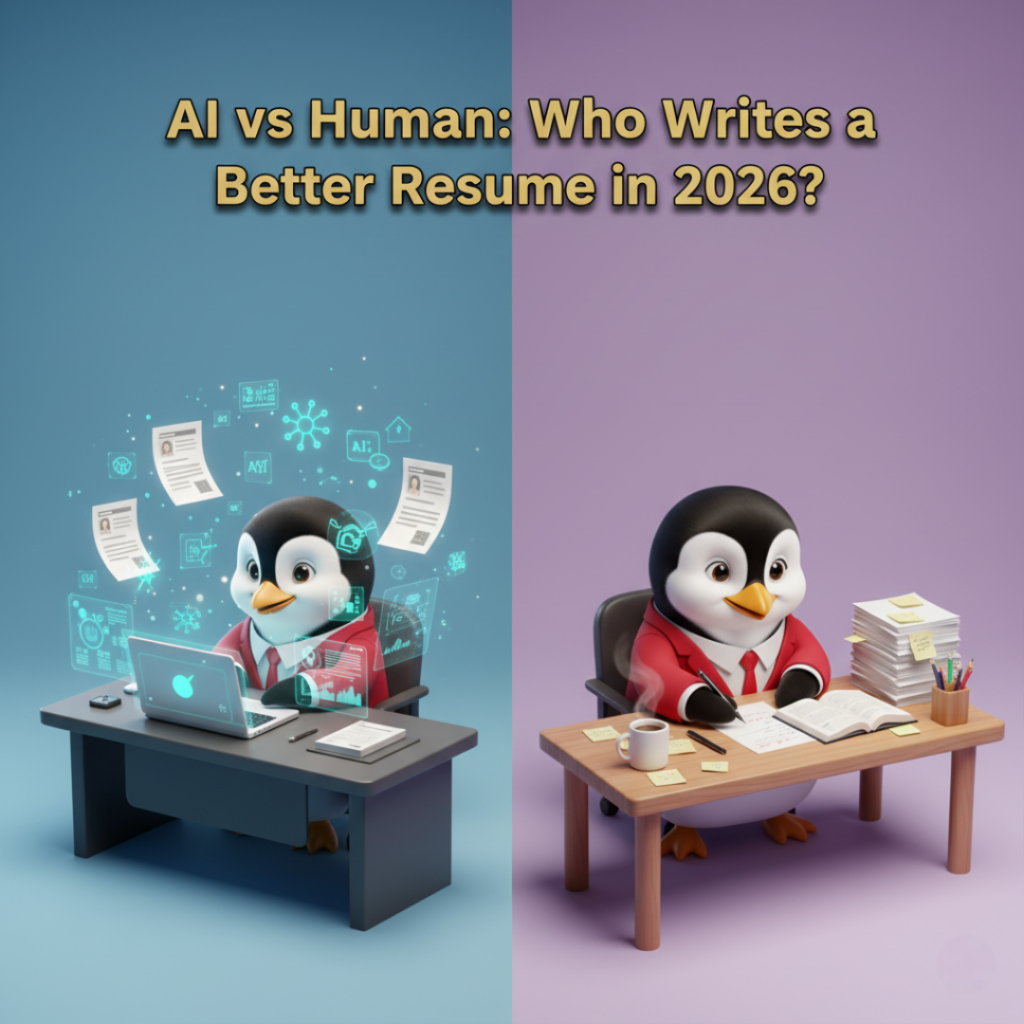
Crafting a resume in 2026 feels a bit like choosing a co-pilot: do you rely on a seasoned human writer, or do you let advanced AI do the heavy lifting? The truth isn’t a simple either-or. Instead, it’s a smart partnership—one that starts with AI for speed and structure, then layers on your voice with sharp human edits. Let’s unpack why that combination wins, how to make it work in minutes, and where HRTailor.AI fits in.
The quick verdict
-
When it comes to personal nuance and storytelling, humans win.
-
In terms of cost efficiency and scaling across roles and geographies, AI wins.
-
To achieve the best outcome, start with AI—then humanize the output with your achievements and tone.
How resumes are actually judged in 2026
The Recruiters and Applicant Tracking Systems (ATS) both evaluate your resume, although differently. Therefore, your document must pass two gates:
- ATS gate: The system evaluates formatting, keywords, and overall structure. Clear headings, standard section names, and relevant terms from the job description improve parsing accuracy.
- Human gate:
Recruiters focus on clarity, impact, and authenticity. In seconds, they scan for measurable results, scope of responsibility, and signs of progression.
Consequently, the “winner” is the approach that ticks both boxes—every time, and at scale.
Human strengths you still can’t beat
Even with smarter tools, people bring critical advantages:
- Context and nuance: A human can connect your unusual career pivot or career break to a compelling narrative.
- Industry flavor: Skilled writers translate insider language to accessible, recruiter-friendly wording.
- Storytelling with metrics: Humans can ask, “What happened because you did this?” and push you to quantify outcomes.
- Taste: Good editors know when a bullet is bloated, generic, or just right.
However, humans can be slow, expensive, and inconsistent from writer to writer.
What modern AI gets spectacularly right
Today’s systems are far beyond basic templates. They:
- Match role + location norms automatically: US one-page standards, India two-page detail, UK/EU academic CVs, and Middle East photo/personal info norms—done.
- Extract keywords and achievements: They surface missing skills, hard numbers, and domain-specific terminology from target job posts.
- Format for ATS: Clean headings, compatible fonts, and minimal graphics that won’t break parsing.
- Iterate instantly: You can generate variants for different roles, seniorities, or regions in seconds.
Still, AI needs your input to avoid sounding generic. It writes fast; you add the proof.
The hybrid playbook: AI first, human finish
This is the workflow top candidates use:
- Feed the raw material: Provide roles, dates, responsibilities, top achievements, tools, and metrics.
- Aim AI at a real job post: Let it align keywords, seniority signals, and section order.
- Pick a geo-correct format: One-page US tech role? Two-page India managerial role? Let the system adapt.
- Humanize it: Add color—specific numbers, product names, market sizes, team scope, client logos (when allowed).
- Trim the fluff: Replace vague verbs (“helped,” “worked on”) with outcome-driven bullets.
- Run an ATS sanity check: Confirm headings, spacing, and keyword density look natural.
- Ship variants: Save a master version, then spin targeted versions per role.
With this sequence, you get speed and voice—without ballooning costs or timelines.
Side-by-side scenarios you’ll recognize
Scenario A: Mid-career PM switching industries
- AI strength: Translates platform lingo to the new domain, rearranges sections, and highlights transferable impact.
- Human polish: Adds the one killer bullet—“Launched X feature → +18% retention in 90 days”—that makes a hiring manager pause.
Scenario B: Fresher aiming for first role
- AI strength: Surfaces academics, projects, internships, hackathons, and relevant tools neatly.
- Human polish: Chooses the 3 standout projects and elevates them with outcomes, not process.
Scenario C: Senior leader targeting global roles
- AI strength: Builds multiple geo-specific formats quickly (US/UK/UAE/India).
- Human polish: Adds strategic scope: budgets, team sizes, regional coverage, and board-level wins.
Common myths—debunked
- “AI makes cookie-cutter resumes.” It can, if you feed it thin inputs. Give it data, and it reflects your uniqueness at scale.
- “Humans always beat AI.” Not for ATS standards, speed, and multi-role iteration.
- “Graphics impress ATS.” Usually the opposite. Minimalist, parsing-friendly layouts work best.
What hiring teams actually want to see
Even in creative roles, hiring managers skim. Therefore, lead with:
- A crisp summary: Role, domain, and core impact in 3–4 lines.
- Achievement bullets: Start with the result, then explain the action.
- Evidence: Numbers, complexity, scale, and stakeholder breadth.
- Toolchain: Only those that matter to the job you want now.
Where HRTailor.AI fits—and why it’s different
HRTailor.AI is built for real-world hiring, not just pretty PDFs. It combines:
- Geo-aware formatting: USA one-page, India two-page, UK/EU CV, and Middle East norms.
- Keyword intelligence: It analyzes target job posts and infuses relevant terminology naturally.
- ATS-clean structure: Standard headings, clean spacing, and parsing-friendly templates.
- Role-specific tone: Product, data, finance, HR, sales, marketing—each with the right verbs and proof points.
- Lightning iterations: Generate focused versions for “Senior Product Manager—FinTech, UAE,” then tweak for “B2B SaaS, UK” in moments.
Additionally, Export your resume to Word or PDF and reuse profile data for targeted applications.
Tip: Use the master resume inside HRTailor.AI as your source of truth. Then spin targeted versions per application in under five minutes.
Final takeaway
In 2026, the smartest answer isn’t “AI vs human.” It’s AI for precision and speed, plus human for voice and credibility. Start with the machine to nail ATS and structure. Then finish with your experience, outcomes, and personality. With that, you’ll ship sharper resumes, faster—and for more roles—without burning weekends.
How HRTailor.AI helps you do this now
-
Generate geo-correct, ATS-clean resumes in minutes.
-
Your language is automatically aligned to specific job postings.
-
Each application can have a tailored version in just a few clicks.
- Export, share, and re-use your profile confidently.
Ready to test it? Build your next role-ready draft with HRTailor.AI, then humanize it in five minutes flat.